
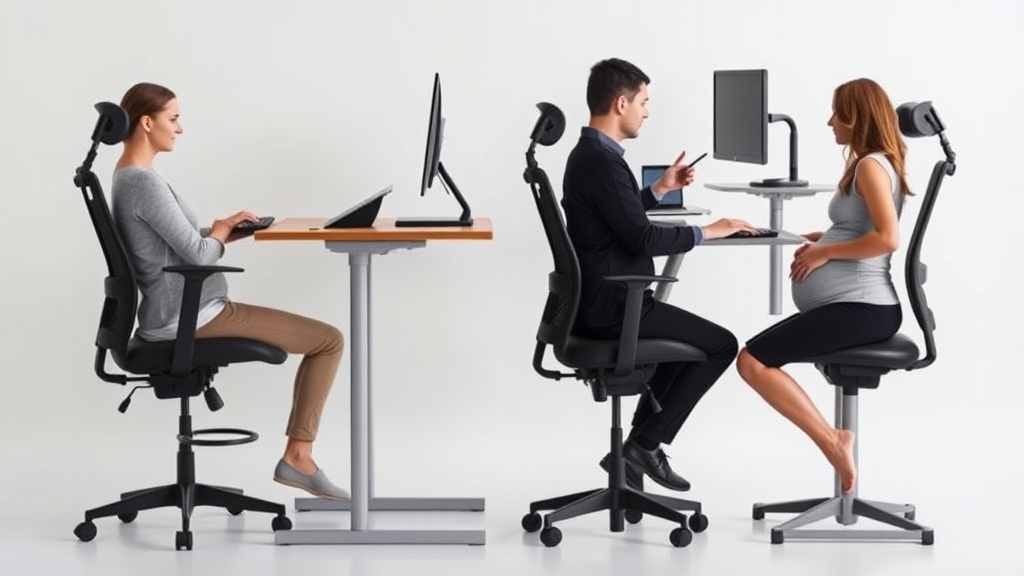
Why Most Chair Reviews Fail Tall, Short, and Pregnant Users
If you’re tall, short, or pregnant, you’ve likely encountered a common frustration when shopping for ergonomic office chairs: most chair reviews don’t address your specific needs. You want a chair that fits your unique body proportions and condition for comfort during long work hours, but typical reviews often focus on “average” users with little consideration for variations in seat depth, lumbar adjustability, or armrest configurations. This disconnect leads to frustration, discomfort, and potentially harmful posture when sitting for 8+ hours a day.
In this article, we’ll explore why most chair reviews fall short for tall, short, and pregnant users, what ergonomic features genuinely matter for these groups, and how to better assess chairs beyond marketing fluff and generic ratings.
See also: 7. The best budget ergonomic chair under 250 dollars across six body types
What Most Chair Reviews Miss
The Problem with Generic Reviews
The majority of chair reviews focus on aesthetics, basic comfort, material quality, and overall value, often based on the reviewer’s own experience—usually someone within the “average” height and body range (roughly 5’6” to 5’11”). This approach ignores the critical fact that ergonomic furniture isn’t one-size-fits-all.
Key ergonomic dimensions like seat depth, lumbar support range, and armrest adjustability dramatically affect user comfort and health during extended sitting—especially for users who don’t fit the average body type:
- Tall users often need deeper seats and extended lumbar adjustability to support longer legs and a taller spine.
- Short users need shallower seat depth to avoid pressure behind the knees and ensure feet reach the floor.
- Pregnant users require lumbar support that adapts to changing body shapes and consider ease of getting in and out of the chair.
When reviews do not measure, test, or report on these adjustable ranges clearly, the information becomes almost useless for these important user groups.
How Fit Factors Impact Different Users
Ergonomic comfort hinges on a “measured fit.” Here are three fit factors frequently overlooked or underreported in reviews:
1. Seat Depth (Measured Fit)
- Tall users benefit from a seat depth of 18–20 inches to fully support their thighs without cutting off circulation behind the knees.
- Short users typically need 15–17 inches or less to avoid “dangling legs” and maintain proper posture.
- Seat depth usually connects to the seat pan’s adjustability—a chair with 4D seat depth adjustment is rare but ideal.
2. Lumbar Adjustability Range
- For tall users, lumbar support must be adjustable higher up the back and deeper into the spine curve.
- Pregnant users need lower back support that can accommodate changing curvature without causing pressure points.
- Short or average users might find standard lumbar options sufficient but benefit from adjustable height and depth support for all-day comfort.
3. Armrest Adjustability (4D Travel)
- Armrests that adjust in height, width, depth, and pivot angles (“4D armrests”) can accommodate a range of shoulder widths and allow easier repositioning for pregnant users who may feel restricted by rigid armrests.
- Poorly designed armrests cause shoulder strain or limit movement, especially during extended typing or mouse work.
Why Pressure-Mapping and Real-World Testing Matter
Some higher-end chair manufacturers use pressure-mapping technology in their research and development to optimize comfort by measuring contact points and pressure distribution while seated. Unfortunately, this science rarely reaches typical online chair reviews, which rely on subjective feel rather than objective data.
For example, a chair might feel “comfortable” during a 30-minute assessment, but without pressure mapping or long-term testing for different body shapes, it could cause discomfort or circulation issues over an 8-hour workday—especially if the seat depth or lumbar support is off for your height or pregnancy.
Comparison Table: Ergonomic Fit Considerations by User Group
| Feature | Tall Users | Short Users | Pregnant Users |
|---|---|---|---|
| Seat Depth | 18–20 inches, adjustable | 15–17 inches or less, adjustable | Medium depth; priority on comfort |
| Lumbar Support | Adjustable higher and deeper | Adjustable lower and shallower | Adjustable lower back, cushioning |
| Armrest Adjustability | 4D (height, width, depth, pivot) | 4D preferred for compact fit | 4D for comfort and ease of movement |
| Pressure Mapping Needs | Identifies thigh and back areas | Avoids pressure behind knees | Supports shifting body shape |
| Marketing Copy Issues | Overpromises “fits all” | Ignores seat pan size | Ignores evolving comfort needs |
| Common Review Oversights | Fails to test extended seat depth | Uses only average-height testers | Skips trimester-specific advice |
When to Use Real Fit Data Over Marketing
If you fit outside the “average” user profile, don’t rely solely on brand descriptions or superficial chair reviews. Instead, use these strategies:
-
Check actual adjustability specs: Look for seat depth adjustments in inches, lumbar height/depth range, and armrest 4D capabilities. Generic “ergonomic” claims mean little without numbers.
-
Seek out reviews from users matching your height or condition: Some specialized ergonomic communities and forums provide insights from tall, short, or pregnant users.
-
If possible, try before you buy or purchase from vendors with flexible return policies: An hour in your office chair doesn’t equal a full-day trial but gives initial fit clues.
-
Invest in add-ons if necessary: For example, seat cushions can reduce seat depth for short users; adjustable lumbar pillows serve pregnant or tall backs when the built-in ones fall short.
Common Pitfalls in Chair Recommendation and Reviews
- Assuming “average fit” suits everyone: Many chair descriptions state “ergonomic for all” but don’t provide meaningful details on which body measurements were considered.
- Ignoring pregnancy-specific changes: Lumbar support needs and comfort don’t remain static throughout pregnancy; chair reviews neglect this nuance.
- Overlooking armrest adaptability: Armrests are often reported as simply “adjustable” without details on multidimensional movement crucial for proper placement.
- Underestimating prolonged use effects: Chairs rated after brief testing lack insights into long-term pressure hotspots and discomfort.
Summary
Tall, short, and pregnant users face unique challenges finding ergonomic work chairs because most chair reviews and marketing gloss over critical fit factors. Paying close attention to seat depth, lumbar support adjustability range, and 4D armrest travel—alongside seeking pressure-mapping data or detailed user feedback—will help identify chairs that genuinely support your body during 8+ hour workdays. Watch out for vague marketing claims and prioritize tested, measured fit rather than hype.
Frequently Asked Questions
Q: How can I measure my ideal seat depth?
A: Sit with your back against a wall, measure from the back of your buttocks to the back of your knee. Ideal seat depth is approximately 1–2 inches less than this to avoid pressure behind the knee.
Q: Are armrests adjustable enough on budget chairs?
A: Budget chairs often have limited armrest adjustability (usually height only or none). For better ergonomic fit, look for 4D armrests—height, width, depth, and pivot adjustment are essential.
Q: Can I use lumbar pillows to fix poor chair support when pregnant?
A: Yes, lumbar pillows can help add needed support and cushioning, especially if the chair’s built-in lumbar adjustment doesn’t cover the lower back curve changes during pregnancy.
Related reading
- Ergonomic Chair Adjustments for Users of Different Heights
- 3. Secretlab Titan Evo vs Herman Miller Embody for tall users
- Best Office Chairs for Tall People (6”2”+): Seat Depth, Lumbar Support
- 7. The best budget ergonomic chair under 250 dollars across six body types
- 6. Why the Aeron is wrong for most people who bought it
Our picks worth a closer look
- 750lbs Big and Tall Office Chair with Wide Thick Seat Cushion,Ergonomic Mesh OffCheck on Amazon → — see current price and specs.
- Big and Tall Office Desk Chair 500lbs, Ergonomic Heavy Duty Mesh Desk Chair, ExeCheck on Amazon → — see current price and specs.
- Massage Office Chair, 500LBS Ergonomic Rocking Executive Desk Chairs with 4 PoinCheck on Amazon → — see current price and specs.
- Massage Office Chair with Foot Rest,6-Point Vibration & Heat Executive Office ChCheck on Amazon → — see current price and specs.
- Massage Office Chair with Foot Rest,6 Points Vibration&Heat Executive Office ChaCheck on Amazon → — see current price and specs.